| What is it? | How can you tell if you’ve been cited by AI? | Summary: How to get cited in AI
|
| Being cited by AI means being quoted in the answer to a question asked of Large Language Models (LLMs) such as Google Gemini, OpenAI ChatGPT and Anthropic Claude.
|
Check out the new Search Generative AI performance reports in Search Console.
Or manually test high-intent prompts in generative search tools and then look to see if your domain has been mentioned in the source footnotes or inline citations.
|
1. Consider what the reader really wants
2. Think E-E-A-T 3. Aim for non-commodity content 4. Make effective use of FAQs 5. Pay attention to page structure 6. Check (and double check) your facts 7. Include real world examples
|
We’re all pretty familiar with the fundamentals of SEO by now: write original content based on keyword research which should then result in Google crawling your site and making your page visible to others.
But how do we know if the content we’re creating is any good for AI? What information are LLMs looking for? What is it that are people are asking Large Language Models (or LLMs) about? And how can we tell if what we’re writing is being picked up in an AI response?
Here we take a look at how to find out if you’ve been cited by AI, using a couple of real life examples, before leaving you with our top 7 tips for getting your content ranked by AI.
What does being cited by AI mean?
Being found – or cited – by AI simply means being quoted in the answer to a question asked of LLMs which process and generate text, such as Google Gemini, OpenAI ChatGPT and Anthropic Claude.
What sets AI engines apart from more traditional search engines is that they scan for short, standalone chunks of information in order to answer specific user questions. So if the answer to a question is buried in a long and wordy paragraph, the chances are that AI will skip by it.
How can you find out what questions people are asking AI?
It’s actually pretty simple to find out what people are asking AI – just ask AI!
So if you’re looking to write FAQs for a page on holidaying in Padstow, Cornwall then you might use a prompt for ChatGPT which asks “What are the top 20 questions people are asking about holidaying in Padstow, Cornwall?”
And you will be presented with the top 20 questions and often the suggested answers. By all means use the questions to inform your own FAQs. But make sure to write the answers yourself rather than getting AI to do it for you.
How can you tell if you’ve been cited by AI?
On 3rd June 2026, Google announced in a blog post ‘Introducing Search Generative AI performance reports in Search Console’ that it was “launching new Search Generative AI performance reports in Search Console, including dedicated reports for Search and Discover, to help you understand your site’s visibility within generative AI features on Search.”
These new performance reports show:
- Impressions: How often URLs from your site appeared in generative AI features in Search and Discover
- Pages: Check which URLs appeared within AI features
- Countries: Understand your visibility on a country basis
- Devices: Identify the devices people are using when seeing your website (available for Search results)
- Dates: Monitor your performance over time with hourly, daily, weekly, and monthly granularity
This new functionality, whilst very much in a beta stage, nevertheless provides a useful alternative to manually testing high-intent prompts in generative search tools and then looking to see if your domain has been mentioned in the source footnotes or inline citations.
Real life examples of getting ranked for AI: Case studies
Nearly a year ago we were writing about tactics for getting content ranked by GEO. But what has actually worked for The Content Marketing Team when it comes to getting our clients cited by AI?
Case study 1: Creating ‘free things to do’ pages for YHA hostels
Budget accommodation provider and youth charity YHA (England & Wales) is a not-for-profit voluntary sector organisation which operates over 100 hostels in England and Wales.
The profile of a typical YHA customer is someone who is price driven, cares about the environment and loves spending time in the great outdoors. So supplying them with ‘free things to do’ (such as Horizon 22 in London) in the locality of their next hostel stay takes away several pain points which might otherwise prevent them from booking:
- Having to spend time researching what to do in an area they’re unfamiliar with
- Not wanting to spend lots more money when they’ve already paid for travel, accommodation and food
- Finding out what activities there are in an area other than the obvious. For example, hiking in the Lake District is obvious. But what if you have a problem with mobility? Or it’s raining heavily and your group doesn’t want to get soaked? Or you have small children so scrambling across Striding Edge is probably unwise?
By supplying 10 different options of free things to do in the local area of a YHA hostel, YHA made it significantly more likely that the customer would convert their interest into a booking (the conversion goal).
And the result? When we looked at Generative AI results in Search Console over the last 3 months, we found that 10 of the top 19 performing pages were ‘free things to do’ pages written by us.
Why? Because they’re full of first hand experiences, novel insights and original data.
Case study 2: Positioning MRM as sage experts
Promotional marketing experts MRM wanted to be better positioned as the sage experts in their field through the creation of ‘finger on the pulse’ articles for their Insights pages.
And so, for the last 3 years, The Content Marketing Team has supplied them with blog articles which very much set them out as strategic thought leaders who absolutely know what the customer and the consumer want now, where the market is going next and which trends are here to stay.
Has it worked? Well, again, looking at Generative AI results in Search Console over the last 3 months, we found that 10 of the top 20 performing web pages were blog posts written by us.
And what makes AI want to cite them? This time it’s unique observations, heavily referenced information, expertise and insights.
7 tips which worked for us to get cited by AI
So how would we summarise our own advice for getting cited by AI? Here are seven useful tips that worked for us which we’d love to share with you:
1. Consider what the reader really wants
What is the reader hoping to see on your page? How closely does the content relate to the title? And does it match their search intent?
Use LLMs to find out what people are asking about the topic you intend to cover. And then answer their questions quickly, effectively and with authority. And better than any other article online.
2. Think E-E-A-T
Is your content filler or quality? Of course, unique, original content wins every time.
As we have covered before, E-E-A-T stands for Experience, Expertise, Authoritativeness and Trustworthiness. It is a part of Google’s algorithm although E-E-A-T is not a direct ranking factor itself. However, Google aims to provide results which have a good E-E-A-T rating for its users. So make sure your content conveys your experience, expertise and authority, all of which leads to increased trust in your brand.
And when it comes to AI, E-E-A-T still holds true.
3. Aim for non-commodity content
In their recent article (June 2026) ‘Top AI Pages Have Less Commodity Content Than Top SEO Pages. We Built a Tool to Measure It’ author Sean Fulford defines Commodity content as being “information that a model can already generate without human assistance and timely, real world insights (ie. “how to tie a shoe”).
Conversely, non-commodity content consists of information, observations, expertise, data, experiences, or insights that are not already represented within the model’s existing knowledge (i.e. “the tallest building in Turkey” or “what is the price of oil today”).”
They summarised this in this useful image:
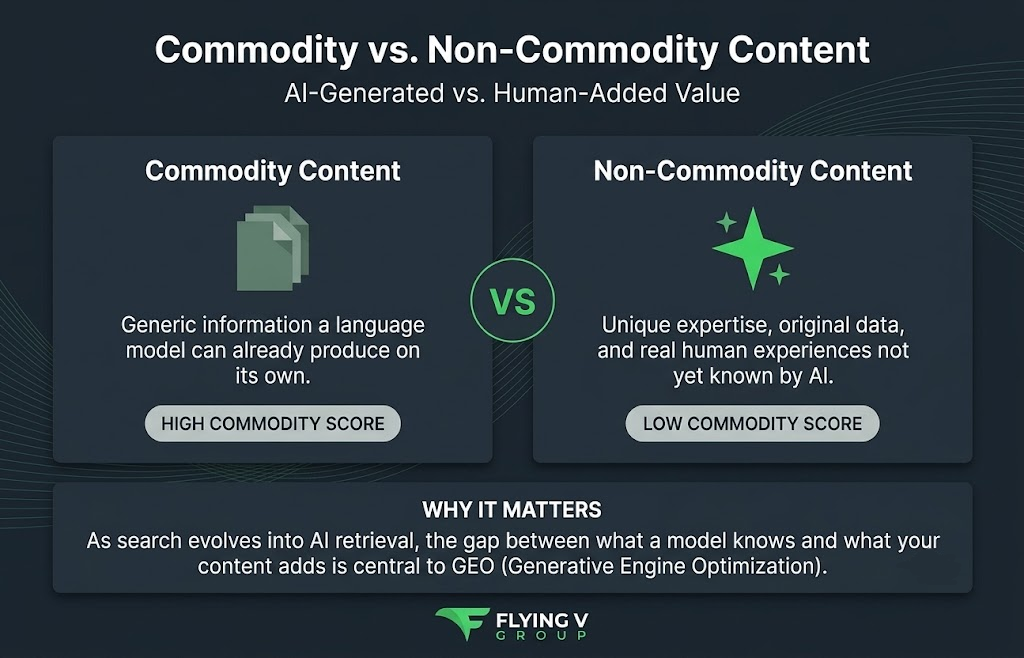
Fulford advises “If your goal is AI citation, high-commodity explainer content works against you. When a page restates what the model already knows, the model answers from its own knowledge and the page rarely earns a citation.”
Fulford concludes “Content that simply restates information already present across millions of documents contributes relatively little additional knowledge.” Whereas “Content containing proprietary research, original data, first-hand expertise, unique observations, and novel insights contributes information that may not already exist within the model’s training distribution.”
The takeaway? Don’t expect to rank for AI if your content contains information AI already knows to be true (E.g. ‘Who wrote Great Expectations?’ or ‘When did the Titanic sink’?).
Instead, where possible, make sure that your content contains information that AI can’t be sure to be true without checking, including:
- proprietary research
- original data
- first-hand expertise
- unique observations
- novel insights
4. Make effective use of FAQs
We’ve previously championed the effectiveness of FAQs and their formatting in our article ‘Are FAQs still relevant in an AI world?’ And of course the answer is yes. They’ve always been popular and the way in which they clear articulate the question and then provide a short, succinct answer means they are perfect for helping you get cited by AI. This is because users tend to ask LLMs direct questions, and the tool will then look for content that mirrors this, as it’s the easiest and quickest route to find the answer.
5. Pay attention to page structure
We’re not just talking about remembering your page hierarchy (although that still matters). Useful techniques for optimal AI & SEO formatting include:
- Clear H1s
- BLUF (Bottom Line Up Front) – putting the most important message at the top of the page
- One clear topic per article (focused intent)
- Logical H2 and H3 hierarchy
- Descriptive headings (not vague)
- Short paragraphs
- Bullet point lists
- Numbered lists
- Tables
- Internal linking
- Referencing trusted sources
- Conclusion with reinforcement
Topic clusters can help with GEO (Generative Engine Optimisation) and Search Everywhere, too.
6. Check (and double check) your facts
Misinformation abounds on the internet and AI is no exception. There are countless examples of where AI has got its facts wrong – or apparently just made them up! So in a world of half-truths, spin and distortion, being clear about the facts really matters.
Make sure to do your research using trusted resources. And include all references.
7. Include real world examples
We’ve previously covered the importance of including real world examples in your content. This is because any examples you can use from real-life will help give credibility to your posts and make them more relatable for your readers.
For instance, you might be more interested in this blog post because it includes two real life case studies, which then differentiates it from many other posts out there on how to get found by AI.
But perhaps most importantly, real world examples in your articles help differentiate your content from AI generated blogs.
Remember Google still very much matters as a search engine
In an article that talks about getting ranked by AI, it’s worth remembering that google still very matters as a search engine.
To put this into context, in his article ‘New Research: Google Search Grew 20%+ in 2024; receives ~373X more searches than ChatGPT’ Rand Fishkin, co-founder of Moz and founder of SparkToro said
“Rarely do I feel as confident giving a definitive comparison. In 2024:
- Google had more than 14 billion searches/day
- ChatGPT had (at the very most) 37.5M searches/day
In 2024, Google received ~373 times as many searches as ChatGPT. The AI tool’s search volume is on a scale similar to Pinterest (~20M/day) and ~one third the size of the ~108M searches/day on DuckDuckGo, though ChatGPT is growing at a faster rate.”
Clearly then, SEO is far from dead.
Looking for help getting cited by AI?
If you’re looking to create content which not only ranks for search engines but also gets cited by AI then we suggest knowing what your customer wants and optimising your content from there.
We would absolutely not suggest that you look to content scaling (moving away from a single-purpose content creation strategy into exponentially producing content at a significantly higher volume using AI tools) as a solution.
But if you’d like help from a team with proven experience in getting cited by AI, then get in touch with The Content Marketing Team today.