| What is AI content scaling?
|
Why would you use it? | What are the risks? |
| It’s moving away from a single-purpose content creation strategy into exponentially producing content at a significantly higher volume using AI tools.
|
No human team can write thousands of pages of content in seconds, can they?
It gives you more output for less effort with faster results.
|
· Publishing inaccurate information and damaging brand trust and reputation
· Content that feels flat or faceless · No E-E-A-T included · Severe Google penalties and traffic drops · Publishing duplicate content
|
AI content scaling can seem like a quick and easy shortcut to increasing your website’s traffic. After all, no human team can write thousands of pages of content in seconds, can they? It gives you more output for less effort with faster results.
According to a recent review, three out of four new web pages now contain AI-generated content (source: Ahrefs), so it seems like more and more brands are turning to this tactic to keep up with content demand while keeping costs low.
However, the reality of AI content scaling is that it’s not without its risks. Not only is AI content prone to mistakes and really needs a human eye for quality control, but it could also mean penalties for your website from Google, resulting in a disastrous loss of traffic.
We’ve already started to see some early-adopter brands experiencing these pitfalls. Read on to find out more about AI content scaling, whether it’s right for your business (spoiler alert: it isn’t!), and how brands are seeing penalties from using it.
What is AI content scaling?
AI content scaling goes beyond simply using AI to create more content for your website. It’s moving away from a single-purpose content creation strategy into producing content at a significantly higher volume using AI tools.
AI is used to create content across blogs, landing pages, product descriptions, and more, often creating more and more webpages and bloat. Brands will often hit on an idea that has worked for them in the past and replicate this exponentially.
For example, a blog post called “10 of the best places to eat pizza in Naples” may be performing very well. So, encouraged by this, the brand will use AI to write:
- 10 of the best places to eat pizza in *insert Italian city here*
- 10 of the best places to eat pizza in *insert European city here*
- 10 of the best places to eat *insert food here* in Naples
And so on and so on. There are an almost infinite number of blog posts you could create using this same formula.
Why are businesses using AI content scaling?
Cuts in marketing budgets and shrinking teams are all leading to content marketers having to penny pinch where they can. Add to this a constant demand for content across a varied range of channels, and it’s not difficult to see why businesses might think that AI content scaling is the answer.
What are the risks of AI content scaling?
So, from what we’ve said so far, you’re probably asking yourself, “But why wouldn’t I scale my brand’s content using AI?” Good question, but there are some significant risks to your website and your brand’s reputation if you do.
The risks of AI content scaling include:
- Publishing inaccurate information and damaging brand trust and reputation
- Content that feels flat or faceless
- No E-E-A-T included
- At risk of severe Google penalties and traffic drops
- Publishing duplicate content
1. Publishing inaccurate information
LLMs (Language Learning Models) may think they know their stuff, but they can often come out with facts that aren’t quite accurate or (on some occasions) completely made up! This is where you really need a human eye to check over all the content, and you can’t physically do this if you’re creating content on such a large scale.
Publishing inaccurate information will damage your brand’s reputation as an expert in its field and can lead to customer disappointment. Plus, it’s a big admin job having to go back over all that content and correct it!
2. Content that feels flat
Even if you get your AI prompts spot-on, the content they produce can fall a little flat and lacking in personality. There’s just nothing that can compete with a talented marketing wordsmith creating human to human content.
3. No E-E-A-T included
It feels like we’ve been banging on about E-E-A-T (Experience, Expertise, Authoritativeness, and Trustworthiness) for quite some time now, and for good reason. Google still rewards these qualities in your content, and they’re so personal that there’s no way they can be replicated by AI tools.
4. Severe Google penalties
If Google thinks your content isn’t valuable, you’re targeting keywords that are unrelated to your business, or you haven’t built trust and authority, then they can penalise your site. And it’s not just us saying this – real brands have actually experienced these penalties.
Tailride is one example of this. Back in 2025, the AI Invoice and Receipt automation platform published 22,000 AI-generated content pages on its website to target long-tail keywords that their users were searching for.
At first, they were getting hundreds of clicks and millions of impressions. However, within 6 months, Google flagged their domain, and their pages all started getting deindexed. They went from 22,000 indexed pages to 1 (their homepage). They lost all of their organic traffic overnight and had to start again, building their website from the ground up and removing all their AI content.
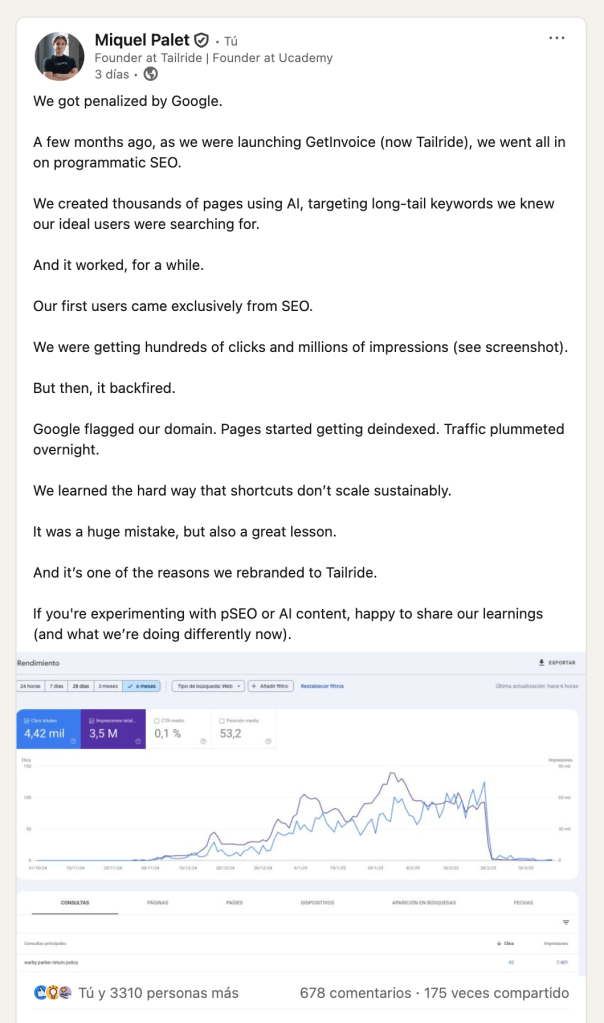
And their learning? “Don’t publish garbage. Thin content, bad targeting, and spammy scale will kill you. Focus on content that actually helps your user. Not just content that ranks.” (source: Tailride).
More recent examples of Google penalising large brands who have used content scaling abound.
In her 2026 article ‘Is Google Finally Cracking Down on Self-Promotional Listicles?’ which looked at Google Ranking Volatility following the December 2025 Core Update, SEO & AI search professional, Lily Ray noted “Many of these sites had recently scaled content quickly, which could be an indication that they are using (or over-utilizing) AI to quickly scale content, perhaps with insufficient human oversight”.
5. Publishing duplicate content
While Google doesn’t necessarily penalise duplicate content, it will choose one version of the page to include in its indexing, and this is usually the more authoritative website. If it determines that there’s deceptive intent behind the duplicate content, then your site can very quickly be de-indexed.
Content that is generated by AI is created using information already found online, so it stands to reason that some of this may be considered duplicate content. And it’s not just in the eyes of Google that you could be punished. Your brand’s reputation amongst customers could also be in danger.
Why we wouldn’t recommend content scaling
AI content scaling might seem like an easy way to progress, but in reality, it’s a shortcut that could cause significantly more harm than good to your website. More pages doesn’t necessarily equal more visibility and faster output doesn’t create authority.
Content that exists just because it was easy to produce isn’t likely to get results.
How to scale content using humans
If you’re looking for content that resonates and really generates traffic, then your best bet is to keep the human touch. If you’d like to level up your content game, get in touch with The Content Marketing Team today to find out how we can help.