
The world of search is changing and there’s no doubt about it. So, how do you know which line of work to back and where to spend your precious time and money?
To answer this, simply consider two questions:
- Whether the adoption of AI is going to wipe out search engines
- What’s making websites show up in AI responses
Starting with question 1: is AI going to wipe out search engines?
- What share of the market does AI have?
- Are there always going to be people who don’t use it and prefer the perceived safety and comfort of search engines?
There’s a brilliant article by Glenn Gabe, a Search Engine Land columnist with almost three decades of SEO experience under his belt. The article is called ‘AI Search Currently Drives Less Than 1% of Traffic To Most Sites, Google Is Still Dominant, and Watch The Long-term Risk of Ignoring Google Search’.
Let’s break that down a little bit. This tells us that most sites aren’t getting much traffic from AI – but is that because their sites aren’t well optimised; because there’s only a certain type of site that AI bots are rewarding, or because there’s actually not that much uptake of AI?
In reality, it’s probably a mixture of all 3. ChatGPT has been the biggest AI search platform to date and has grown exponentially:
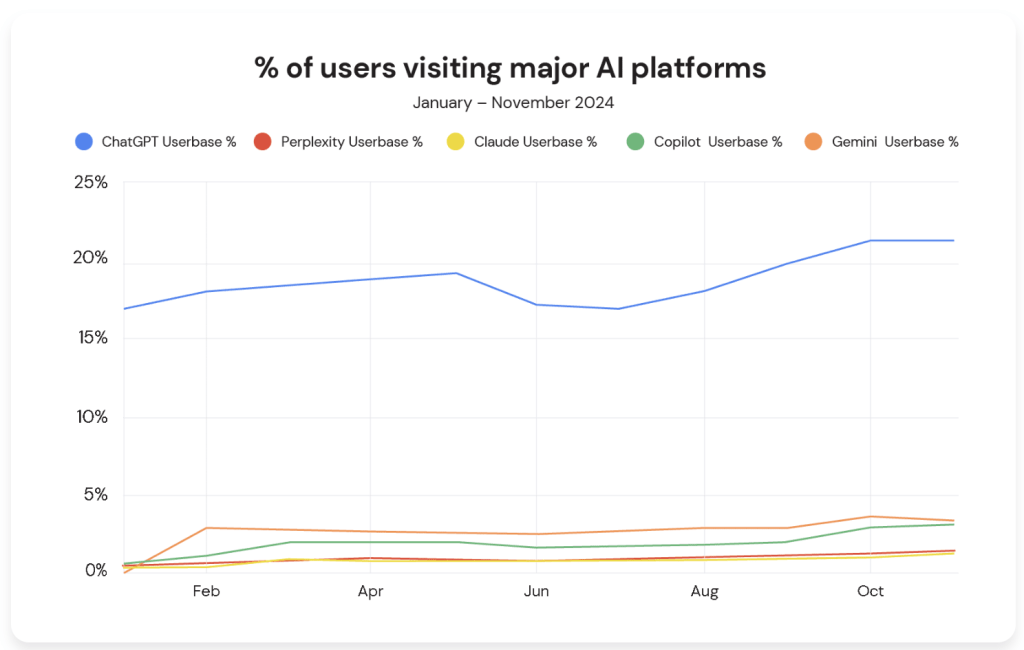
However, ChatGPT has only recently started to link to products and even then it is just products – not services or to direct its users through to a website – unless you specifically ask it to or use ‘ChatGPT search’ which is its own Google-esque search engine.
Just like Google, AI bots want to keep you confined within the realms of their services, not to wave you goodbye with a hanky as you set about your merry way finding what you actually want on the world wide web. So, the main point here is that regardless of uptake and popularity, AI isn’t actually driving that much traffic to websites – yet.
Google continues to grow (by 20% in 2024)
Rand Fishkin, co-founder of Moz and founder of Sparktoro:
“Rarely do I feel as confident giving a definitive comparison. In 2024:
- Google had more than 14 billion searches/day
- ChatGPT had (at the very most) 37.5M searches/day
In 2024, Google received ~373 times as many searches as ChatGPT. The AI tool’s search volume is on a scale similar to Pinterest (~20M/day) and ~one third the size of the ~108M searches/day on DuckDuckGo, though ChatGPT is growing at a faster rate.”
And on the point of uptake, let’s take a step back for a moment. Thanks to free will, it would be pretty much impossible for AI to completely deplete search engine usage. There will always be people who aren’t interested, or want to stick with what they already know:
- Microwaves? No thanks, I don’t want my food zapped – if it looks like magic, it’s not coming near my soup
- Paid search ads? No thanks, I’m a millennial – I’ve never trusted those light yellow boxes at the top of search results
- Veganism being good for the planet, your body and kind to animals? No thanks, I’ll stick with my cheeseburger
- Coca cola? Yes, please! Let’s forget water ever existed and even bathe in the stuff
Secondly, there are websites that AI bots will steer clear of recommending
These are sites which:
- Don’t contain high-quality, useful content that clearly answers a question
- Don’t perform well from a technical perspective and so take more ‘energy’ for an AI bot to parse and comprehend
- Aren’t getting external links, usually because the content on the site is minimal, low-value and lacks authority
- Don’t have EEAT covered – no authors, no statistics, no citations, little to no reviews, no real first-person experience etc.

Moving on to question 2: What’s making websites show up in AI responses?
- What is making some sites appear in thousands of AI overviews and in LLM responses, while others literally don’t feature at all?
- Did it happen overnight, or is what those sites have been doing for years and even decades, been what’s made AI take a shine to them?
Let’s start by looking at what’s making some sites appear in AI responses, while others aren’t (spoiler – these are very similar to what helps a website rank on search engines).
AI bots tend to gladly consume content which has the following characteristics:
- High quality EEAT – just like search engines, each AI platform wants to be your go-to, so it’s in their best interest to give you a useful, helpful answer that you can trust – so you don’t shoot off to one of their many competitors instead
- Lots of relevant links from other websites
- High quality, unique, straightforward, valuable, content that doesn’t just answer questions, but adds something more: real honest stuff with both qualitative and quantitative comparisons: be it opinion, research, statistics or just something interesting that other sites don’t have, like a free tool
- A technically sound infrastructure, which although may have issues (which website doesn’t?) makes it easy for AI bots to chew through in order to consume the content
- A website that signposts what each page is about, using schema markup and indexation rules that allow AI bots to see what’s on offer, as though they were looking to order from a menu
- Content that’s formatted in easily digestible formats – think tables, bullet points, plenty of headings
- Positive sentiment throughout the world: from how people are talking about a brand on social media and forum-based sites like Reddit to the anchor text used to link to a site from another site, what’s being said in reviews and even personal emails *gulp*
- Good rankings to begin with – according to an article by Search Engine Land ‘75% of Google AI Overview links come from top 12 organic rankings’ and that just makes sense
The last point here, around having good rankings to begin with is a great segway into our next foray into whether sites appearing in AI results have just started doing something *magical* to get here, or whether they’re doing well because of many years of search engine optimisation. Cutting to the chase: it’s the hard work that’s been done so far that’s making sites shine.
Cutting to the chase: it’s the hard work that’s been done so far that’s making sites shine.
SEARCH IS SEARCH
Whether it’s TikTok, Google, Bing, Alexa or ChatGPT. We’re all the new version of the Yellow Pages, just with different formats, iterations and outcomes. And while not everyone will migrate to TikTok, just like not everyone will migrate to ChatGPT, Gemini, Perplexity et al, the best way we can keep up with the channel most people are using to search with is to optimise our websites and the content within them.
The best way we can keep up with the channel most people are using to search with is to optimise our websites and the content within them.
And yes, you may well have realised this already, but: SEO shouldn’t get in the bin just yet, then. In fact, SEO experts are used to working out what works and what doesn’t – quickly – and adapting to change – often – so are arguably best placed to lead your expedition into the murky seas of AI Optimisation, the sweaty jungle of Generative Engine Optimisation or just good old ‘Search’.
All you need to do is get on board.